
Ancient Spirals
From the Aboriginal people of Australia, to the Samoans of the South Pacific to the Aztecs in Mesoamerica, nearly every culture in the world has a petroglyph or marking of spirals. Though they have a variety of meanings, they are all present.
From the Aboriginal people of Australia, to the Samoans of the South Pacific to the Aztecs in Mesoamerica, nearly every culture in the world has a petroglyph or marking of spirals. Though they have a variety of meanings, they are all present. So it was little surprise for explorers to find similar markings scrawled on the walls of a small cave along the coast of Ireland. However, upon further investigation, the markings hidden beneath the rubble of a collapsed ceremonial shrine were just a portion of a much larger symbol that had never before been seen especially coming from the Celtic culture generally known to have inhabited the area.
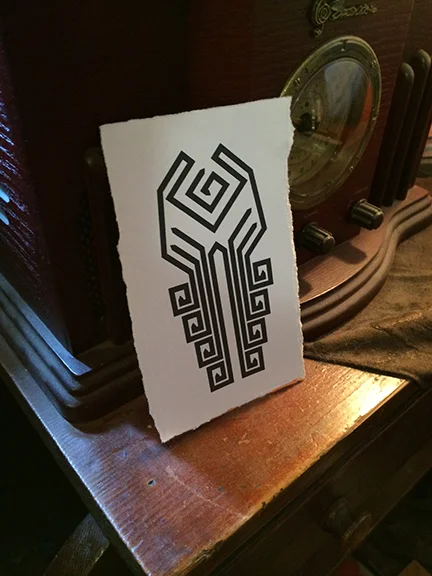
Pictured here is a recreation of the mark found in the Irish cave.
Typically, spiralled symbols found previously in the area are comprised of curved lines forming a triskelion. The sharply geometric spirals of this symbol are strange and out of place. They coalesce to form a graphic representation of a creature resembelling a cephalopod or perhaps the face of a long dead God. Perhaps both.
When observing the massive petroglyph witnesses reported a general unease in it's presence. Shortly after, nearly all members of the discovering party exhibited symptoms of nausea and vertigo. One member reported no effects at the time but was noted to have been particularly enthrawled. Later that evening he was discovered nude, kneeling in front of the image, knees bloodied from the sharp debris of the shrine staring vacantly at the central spiral. Friends of the man claim that he no longer seems to be the man who entered the cave.
Though no additional ill effects of the incident have been reported, the other expedition members refuse to return to the site.
Cthulhu Fhtagn, Indianola, TX
...Indianola was rebuilt, only to be wiped out on August 19, 1886, by another intense hurricane, which was followed by a fire...
Subject: Unknown Deity; Likely Cthulhu
Age: Unknown
Materials: Unknown
Discovered: Indianola, Texas August, 1886
Indianola is a ghost town located on Matagorda Bay in Calhoun County, Texas, United States. The community, once the county seat of Calhoun County, is a part of the Victoria, Texas, Metropolitan Statistical Area. In 1875, the city had a population of 5,000, but on September 15 of that year, a powerful hurricane struck, killing between 150 and 300 and almost entirely destroying the town. Indianola was rebuilt, only to be wiped out on August 19, 1886, by another intense hurricane, which was followed by a fire. Source:Wikipedia
Following that Hurricane, there was a lot of legend and folklore that arose pertaining to the fate of the town and whether or not the disasters were provoked or perhaps invoked as a result of conjuring or witchcraft.
This speculation was never confirmed, however, at the epicenter of the ruined area, this small idol was recovered standing atop an undisturbed altar. Carved from an unknown material resembling an exotic hard wood, the idol stands several inches tall and is incredibly light for it's appearance. This little idol certainly inspires more questions than it answers.

No further information is available at this time.

The Case of the Curious Cranium
Six days following his return from a research trip into rural Spain, Doctor Anthony Vestagé, Professor of Occult Studies was due to deliver a lecture pertaining to the findings of his investigation. He never arrived at the lecture hall. In fact, he had vanished without a trace.
Six days following his return from a research trip into rural Spain, Doctor Anthony Vestagé, Professor of Occult Studies was due to deliver a lecture pertaining to the findings of his investigation. He never arrived at the lecture hall. In fact, he had vanished without a trace. The good Doctor was researching a cult, which was believed to have dated back to the time of the inquisition. The doctor was seen by a student, one James Aurthur, arriving via train to the University clutching a small crate beneath his harm, muttering to himself. He was then seen by several of the custodial staff entering his office, locking the door behind himself. The staff did not remark his departure that night, and his office remained locked for the remainder of the week.
Strange Gilt Skull found in the locked office of Doctor Anthony Vestagé, Professor of Occult Studies
After failing to appear at his lecture, and several unsuccessful attempts to contact him, the Doctor's Wife, Agnes, consented to a search of his office. Upon entering, authorities remarked that there was a sudden rush of air, as if the room was pressurized, which was followed by a faint but lingering order of sulfur and sea air. The office was disheveled though no more than usual. Upon the desk was the pried apart remains of the Doctor's mysterious crate, which was empty save for some packing straw. Next to it sat a strange human skull, etched and gilt with an odd pattern of lines and celestial bodies. The skull sat atop a note, scrawled with one word, or perhaps a name, "Örñe".
The Good Doctor Vestagé has never been heard from again. The skull was taken as evidence, however, it was soon stolen by a Police Sergeant, who also disappeared shortly after. The skull resurfaced years later in the private collection of one Roger Daggett, after his death.